
Your Team Probably Doesn't Have A People Problem
It happens all the time. A leader calls me because there is tension between staff members. Sometimes it is two people. Sometimes it is a whole team. And the ask is almost always the same: "Can you come do some team building?"
So I go in and collect data. One-on-one interviews, sometimes a survey, whatever gets people talking honestly.
And what I usually find is that the conflict is not really between those people at all. It is not that person A does not like person B. What I am looking at is a symptom of something bigger.
Usually it is misalignment. You ask five people what the team is there to do and you get four different answers. Or people do not agree on who owns what, or on how the work is supposed to move. Left alone long enough, that misalignment wears on the relationships. So the problem starts with not being aligned around the team's goal, but where you finally see it is in how two people treat each other in a meeting.
Which is why a leader asking for team building or conflict resolution is only getting half the story. You can run the session. People will even enjoy it. But it will not hold, because whatever is causing the friction is still sitting there when everyone goes back to their desks. Team building without addressing the root of the issue is just a bandaid covering a bullet wound.
To fix the relationships, you have to get to the core of what is causing the friction. Do we agree on what this team is here to do? Do we know who owns what? Does my work overlap with yours in a way that means some of it gets done twice and some of it does not get done at all?
Those are the questions that change things.
The Problem Beneath The Problem
This pattern is old enough to have a literature.
In 1972, Richard Beckhard wrote a short paper on team building that named four things a team needs: Goals, roles, processes, and relationships. In 1977, Irwin Rubin, Mark Plovnick, and Ronald Fry turned it into a pyramid and worked out how to use it to find problems.
The pyramid is not a ranking of what matters most. It shows how one thing causes the next. Unclear goals create confusion about who does what. Confusion about roles breaks the process. And a broken process wears on the people.
So the problem you can actually see is usually the last one in the chain, and the least likely to be the cause.
That is the uncomfortable part, because the friction between people is what people see first. Nobody calls a consultant to say, "our goal is unclear." They call to say two people cannot work together, or morale is low, or people are resisting the change.
Those problems are real. They are just rarely where the trouble started.
Eighty, Sixteen, Three, One
There is a ratio that travels with this model, credited to Noel Tichy. It is worth sitting with, because of how lopsided it is.
About eighty percent of team conflict comes back to unclear goals. Of what is left, about eighty percent comes back to unclear roles. Of what is left after that, about eighty percent comes back to the process. Which leaves roughly one percent that actually starts between two people.
Eighty. Sixteen. Three. One.
While that number comes from one researcher's experience, not a controlled study, it gives us a good direction to look in when we're building teams and diagnosing what is going wrong. The exact figures are not the point. The size of the gap is the point.
Now think about where organizations spend their team development money. Retreats. Personality assessments. Communication workshops. Conflict resolution. Almost all of it aimed at the smallest part of the problem.
Even if the real split is much softer, the pattern still runs the same way. The causes sit near the bottom. The attention goes to the top. And that gap is where the money goes.
There is a reason it happens. Friction between people is visible and uncomfortable, so somebody has to respond to it. An unclear goal is not as obvious. Everybody can keep right on working without ever saying out loud that they are not sure what they are working toward.
One creates urgency. The other creates a slow drift you only notice looking back.
Build from the bottom. Diagnose from the top.
Here is how we draw it.
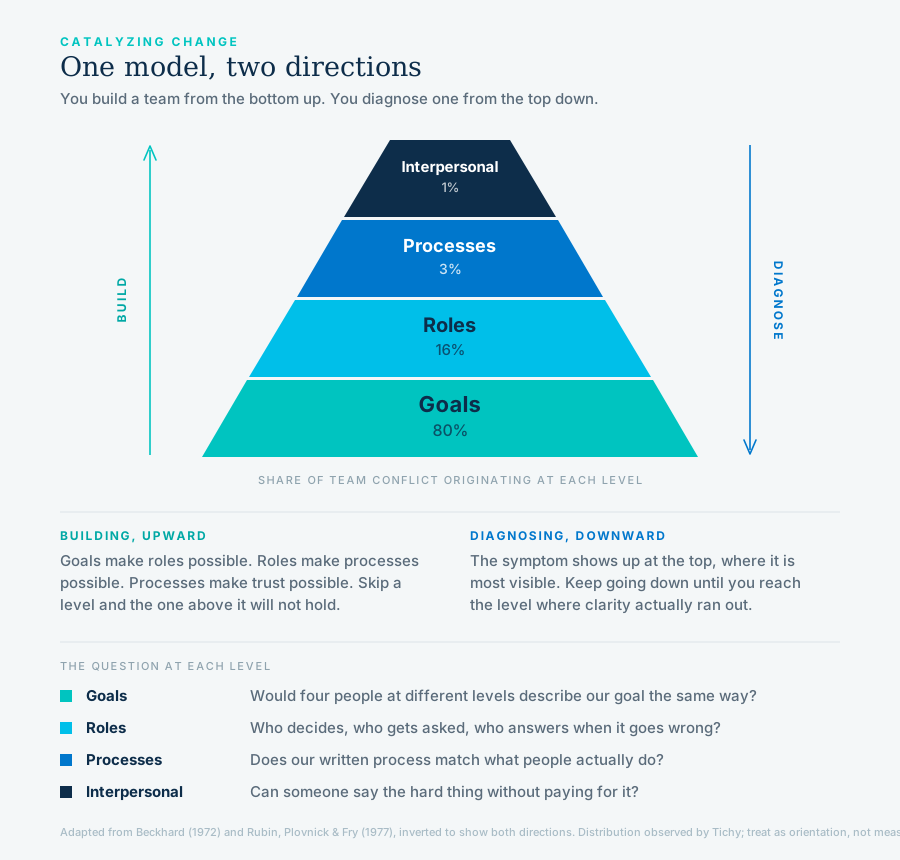
Traditional versions of the model put goals at the narrow top. We flipped the pyramid because it makes the working logic easier to see.
You build from the bottom. Starting a new team, launching a change, or repairing something that fell apart, you begin at the foundation and work your way up. Goals make roles possible. Roles make the process possible. And a working process is what lets people trust each other. Skip a level and the one above it will not hold, no matter how much attention you throw at it.
You diagnose from the top. When something is already broken, you start where the problem is loudest, which is almost always at the top. Then you keep going down until you find the level where things stopped being clear.
The sizes match the numbers this way too. The widest level carries most of the likely causes. The narrowest carries the fewest.
The Four Questions
Saying "we have a people problem" is too blunt to be useful. That one phrase covers four different problems that need four different responses, and most teams are stuck on at least one of them.
Do We Mean The Same Thing?
Not whether a goal exists. Whether the people doing the work actually share it.
And asking the leadership team will not tell you, because they were in the room when it was decided and they will report agreement every time. Ask four people at different levels, separately, and then compare their answers to each other rather than to yours.
Here is what it looks like from the outside: Work that is on plan and somehow not adding up. Two teams both certain they are doing the right thing. A strategy document that keeps getting revised and that nobody outside the room can explain.
Is It Clear Who Owns What?
Not the org chart. Who actually decides, who has to be asked, and who answers for it when it goes wrong.
This one usually falls apart where two teams meet, when each thinks the other owns something, or when both think they do. Decisions get made twice. Work sits while somebody waits on an approval nobody is sure they need.
You will hear it, too. It sounds like "I thought you had that."
Does The Process Match Reality?
How work and decisions actually move, which is often not how the written process says they move. Most organizations have both, and the gap grows quietly, because it is nobody's job to notice.
You can see it in meetings nobody can explain the point of, in decisions that get reopened a month later because it was never clear they were final, and in information showing up after it would have helped.
Can People Say The Hard Thing?
Can somebody raise a problem, disagree with a senior leader, admit a mistake, or say something true and inconvenient, without paying for it?
When they cannot, they mute themselves. And then problems surface late and expensively, the real conversation happens afterward in twos and threes, and silence gets read as agreement.
Why The Order Matters
If more than one level is weak, and usually more than one is, work on the lowest level. Starting from the goal.
That distinction matters, because the upper levels almost always show symptoms rather than root causes. Strain between people is the buildup of everything underneath it, so of course it looks the worst.
I want to be careful here, though. The model tells you where to look first. It is right often enough to be worth following, but it is not a law.
What it saves you from is expensive and common. An organization spends a year on culture work, communication training, and team building, sees nothing improve, and decides people are the problem. Meanwhile, the goal was never clear, and everybody was making perfectly reasonable decisions inside a confusion nobody had named.
What To Do If You Are In It
What I keep coming back to is that the information is already in the building. Somebody knows the goal is unclear. Several people know exactly where the process breaks. They have just decided, usually correctly, that saying so is not worth what it would cost them.
So my first move in a new engagement is not a framework or a workshop. It is talking to people one at a time, asking questions specific enough that the honest answer is easier to give than the polite one.
The wisdom is already in the system. The work is making it safe enough to come out.
If you are reading this because something is not working and you have been calling it a people problem, the useful question is not how to fix the relationships.
It is one level down, and then one down from there, until you find where things stopped being clear.
That is usually closer to the bottom than anyone expects.
Sometimes It Really Is A People Problem
And friends, I'll say this: Sometimes you look underneath the friction and the foundation is solid. The goal is clear. People know who owns what. The process works. And people still cannot work together.
When that happens, there are other places to look. For example:
Psychological safety: whether people believe they can speak up, disagree, admit a mistake, or ask a question without paying for it. Amy Edmondson's research is the place to start here, and it is worth saying that this is not about whether people are nice to each other. It is about whether speaking up feels worth the risk.
Power: when one person has more ability to set the terms, shape the story, or impose consequences, so the conflict is not taking place on equal ground.
Bias: when assumptions about someone's identity or competence shape how their actions are interpreted, whose judgment is trusted, and who gets the benefit of the doubt.
And often, these dynamics intersect with the things GRPI helps us see.
Say somebody on the team already had doubts about whether a colleague was competent. Then the goals get murky and the roles overlap. Work gets done twice. Deadlines slip. Things fall through the gaps.
None of that is any one person's fault. But the person with the doubts now has "evidence." Every dropped ball confirms what she already believed. The misalignment did not create the bias. It fed it.
So sort out the goals and roles and you take the evidence away. That helps. It does not undo the belief. And if you work on only one of them, you will not get the result you were after.
That mix is why so many team problems survive a single fix.
Let's Untangle This Together
So, that people problem you think you have?
It may be a people problem. It may be a goal, role, or process problem showing up between people. More often, it is both, feeding each other until nobody can tell where one ends and the other begins.
That is the work we do at Catalyzing Change.
We go into organizations, listen to the people inside them, and help untangle what is happening from where it started. We look beneath the visible friction to find the goals that are not shared, the roles that are not clear, and the processes that no longer match reality.
Because the goal is not to make the conflict disappear for a few weeks. It is to understand what is creating it and address it at the right level, so the team can build a way of working that holds.
And you do not have to diagnose the problem before our call. Working that out is the job.
We built a short assessment around these four questions. 12 questions, about 4 minutes. It will show you where the problem is likely starting, or, if the foundation is already strong, which area is your lowest.
Take The Foundation CheckAnd if this sounds like what your team is living with, let's talk.
Beckhard, R. (1972). Optimizing team-building efforts. Journal of Contemporary Business, 1(3), 23-32.
Rubin, I. M., Plovnick, M. S., & Fry, R. E. (1977). Task-oriented team development. McGraw-Hill.
Raue, S., Tang, S., Weiland, C., & Wenzlik, C. The GRPI model: an approach for team development. Systemic Excellence Group white paper.
Tichy, N. M. (2002). The cycle of leadership: how great leaders teach their companies to win. HarperBusiness.
Edmondson, A. (1999). Psychological safety and learning behavior in work teams. Administrative Science Quarterly, 44(2), 350-383.